
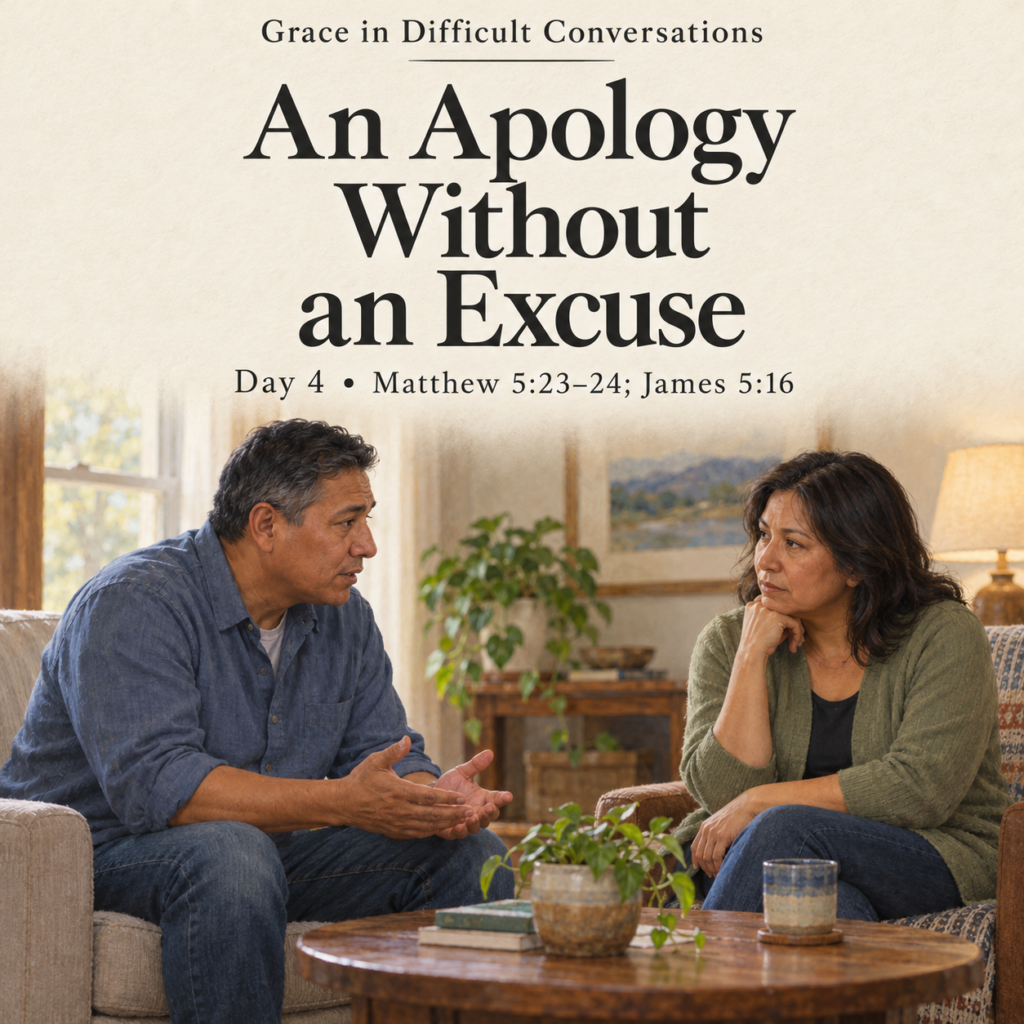
Day 4 — An Apology Without an Excuse
Grace in Difficult Conversations
“So if you are offering your gift at the altar and there remember that your brother has something against you, leave your gift there before the altar and go. First be reconciled to your brother, and then come and offer your gift.”
— Matthew 5:23–24, ESV
“Therefore, confess your sins to one another and pray for one another, that you may be healed. The prayer of a righteous person has great power as it is working.”
— James 5:16, ESV
“I’m sorry I snapped, but you kept asking me questions.”
Even as the words left his mouth, Mark watched Ellen’s expression change.
She settled back in her chair.
“I was asking when you wanted to leave.”
“I know. It had been a long day.”
Ellen looked down at the folded sweater in her lap.
Mark waited for her to say she understood. Instead, the room grew quiet.
He had come into the living room intending to apologize. Somehow, he had ended up explaining why she should understand his outburst.
He remembered her standing by the door earlier, holding her coat. He had raised his voice and told her to stop bothering him. She had quietly hung the coat back up.
Now he wanted the uncomfortable feeling to go away.
But Ellen was still sitting across from him, hurt by words he had chosen.
Mark leaned forward.
“Let me try that again.”
She looked up.
“You asked a reasonable question, and I spoke harshly to you. That was wrong. You didn’t deserve it. Will you forgive me?”
Her fingers loosened around the sweater.
“Thank you for saying that. It hurt.”
“I know,” he said. “Next time I need a few minutes to finish something, I’ll tell you instead of taking my frustration out on you.”
Ellen nodded, but she didn’t smile.
Mark stayed in his chair. He resisted the urge to ask whether everything was fine now.
For once, he let her tell him how it had felt, without interrupting to explain himself.
Jesus teaches that seeking reconciliation matters enough to interrupt an act of worship. James calls believers to confess their sins to one another and pray for one another. Both passages move us toward honestly addressing wrong.
An apology can lose its meaning when we attach an excuse or shift responsibility. Being tired or frustrated may explain our struggle, but it does not excuse treating someone unkindly.
Today, if you owe someone an apology, name what you did plainly. Ask for forgiveness without demanding reassurance or immediate closeness. Then consider what needs to change.
We cannot make someone accept an apology, and trust may take time to rebuild. We can confess our sin to God, receive His forgiveness through Christ, and take responsibility with the person we hurt. By His grace, our apology can become the beginning of changed behavior.
Prayer
Lord, forgive me for defending words and actions I need to confess. Give me humility to apologize sincerely, patience to listen, and willingness to change. Help me care more about the person I hurt than protecting my pride. In Jesus’ name, amen.