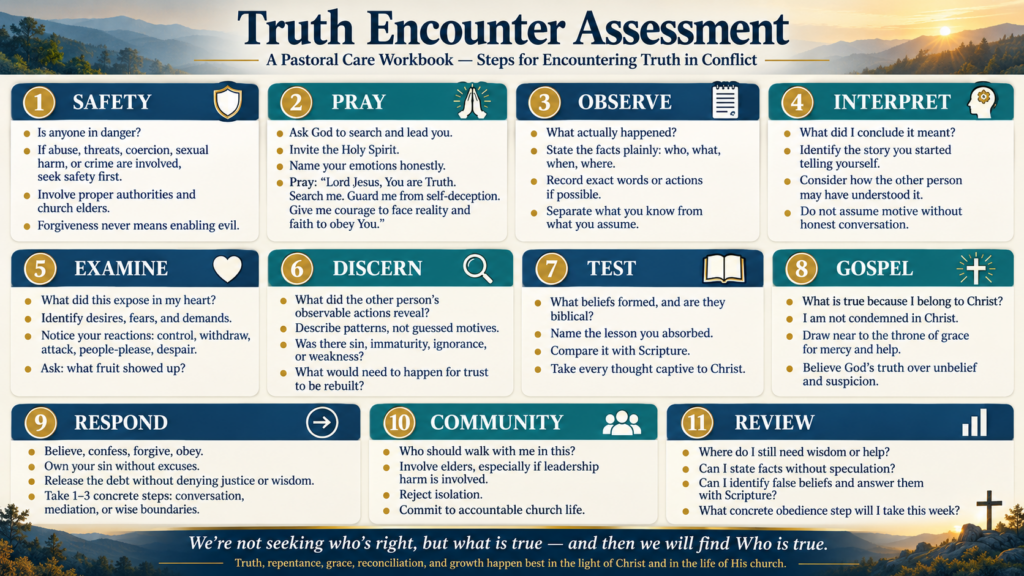
✨✝️Truth Encounter Assessment
Introduction
We’re not seeking “who’s right,” but what is true — and then we will find Who is true.
Jesus said to him, “I am the way, and the truth, and the life; no one comes to the Father but through Me.”John 14:6
We’re not here to win; we’re here to come into the light with Jesus.
For everyone who does evil hates the Light, and does not come to the Light for fear that his deeds will be exposed. But he who practices the truth comes to the Light, so that his deeds may be manifested as having been wrought in God.John 3:20–21
We will take a posture of faith, hope, and love.
We are destroying speculations and every lofty thing raised up against the knowledge of God, and we are taking every thought captive to the obedience of Christ.2 Corinthians 10:5
We walk in the promise that God’s Word exposes us to healing, not to shame.
For the word of God is living and active and sharper than any two-edged sword, and piercing as far as the division of soul and spirit, of both joints and marrow, and able to judge the thoughts and intentions of the heart. Therefore let us draw near with confidence to the throne of grace, so that we may receive mercy and find grace to help in time of need.Hebrews 4:12, 16
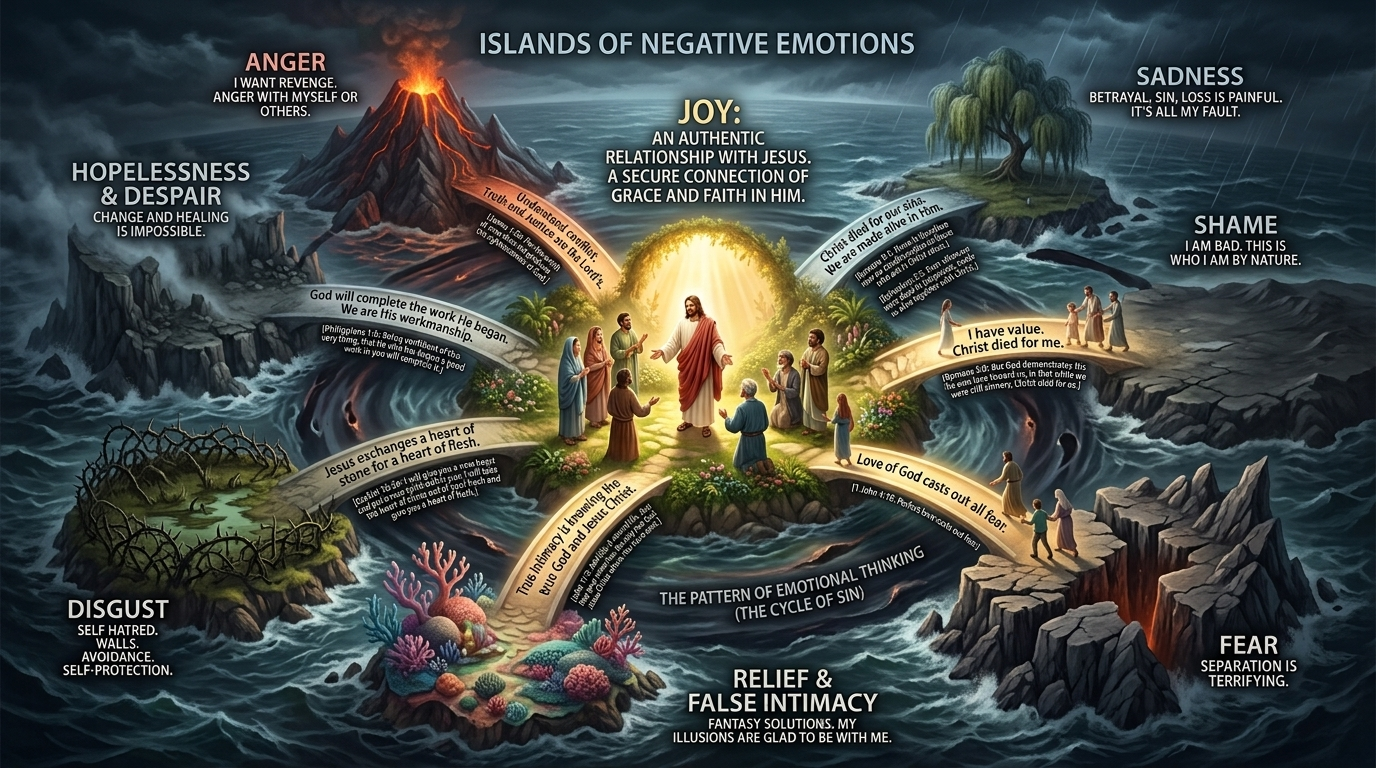
Safety
Safety and Righteousness Guardrail
If any situation involves ongoing abuse, threats, coercion, sexual harm, or criminal actions, the immediate “call to action” may be safety, distance, and involving the proper authorities and church elders (Rom. 13:1–4; 1 Pet. 5:2–3). Forgiveness never means enabling continued evil. “Peace” is not the same as “silence.”
Before continuing: this workbook assumes the situation is safe enough to process prayerfully. If it is not, seek safety and appropriate help first.
Pray
Invite the Holy Spirit
In Psalm 139:23–24, David doesn’t begin by defending himself; he begins by asking God to search him. That is not self-condemnation — it’s confidence that God’s searching leads to God’s leading.
Prayer
“Lord Jesus, You are Truth. Search me. Guard me from self-deception. Give me courage to face reality and faith to obey You. Amen.”
Heart Check
I feel mostly:
Observe
God is omniscient and near; truth is not fragile because God rules reality.
Into your hand I commit my spirit; You have redeemed me, O Lord, God of truth.Psalm 31:5
God does not require you to pretend. He sees what was done, what was missing, what was lost.
Write the event plainly — no motives yet
Questions that keep it clean
Interpret
Humans are finite and fallible; God alone is infallible. That’s why we test interpretations by Scripture and by honest communication.
When I pondered to understand this, it was troublesome in my sight, until I came into the sanctuary of God; then I perceived their end.Psalm 73:16–17
Asaph’s pain was real, but his conclusions were drifting. When he “entered the sanctuary,” his interpretation was corrected by God’s presence and God’s truth. He did not necessarily misobserve what was happening; he misinterpreted what those facts ultimately meant because he was viewing them without the sanctuary perspective of God.
Name your meaning-making
Consider the other person carefully, with humility and in a good light
Key diagnostic
Examine
Doctrine of indwelling sin: even believers carry remaining sin that must be daily put to death by the Spirit. The heart — not merely what was done to us — is the true wellspring of our desires and reactions, so naming it here is the Spirit’s ordinary path to repentance, not evidence of God’s rejection.
Mini Devotional — Luke 6:45
Jesus teaches that words and actions don’t come out of nowhere — they come from the “treasure” of the heart. This isn’t to shame; it’s to locate what must be shepherded.
What did it reveal about you? (Pick 2–3 to focus on.)
Discern
Doctrine of sin and the heart: our problems are not merely external; we are acted upon and we act. This keeps victims from false guilt and keeps sinners from self-justification.
Be cautious, humble, and quick to shed good light.
Test
Doctrine of Scripture’s sufficiency and authority (2 Tim. 3:16–17). We don’t treat feelings as final; we treat God’s Word as final — while taking feelings seriously as indicators. Our interpretation of Scripture must also remain humble and accountable, because Scripture is infallible while our interpretation of Scripture is not.
Mini Devotional — Genesis 3
The serpent’s tactic isn’t only temptation; it’s reframing reality. “Did God really say…?” False doctrine often begins as a plausible interpretation that contradicts God’s Word.
Identify the “lesson” you absorbed
Then test it with Scripture — 2 Corinthians 10:5
Common false “lessons” after church hurt
- “All authority is control.” Instead: authority can be abused, but Christ commands shepherding and accountability done humbly (1 Pet. 5:2–3; Heb. 13:17).
- “Doctrine always divides.” Instead: falsehood divides; truth unites in maturity (Eph. 4:13–15).
- “If someone corrects me, they’re rejecting me.” Instead: faithful wounds can be love (Prov. 27:6; Gal. 6:1).
- “I must protect myself by staying uncommitted.” Instead: love binds itself in covenant (John 13:34–35; 1 Cor. 12).
Gospel
Doctrine of union with Christ and justification by faith: my standing before God is fixed in Christ’s finished work, not in how well I’ve handled this conflict or how the other person has treated me. Whatever was exposed in Steps 5–7, I am not condemned (Rom. 8:1) — I come to the throne of grace as a son or daughter, not a defendant.
Mini Devotional — Hebrews 4:14–16
After God’s Word exposes, we do not run away — we draw near to the throne of grace for mercy and help. Exposure is meant to move you toward Christ, not away from Him.
Believe — faith
Respond
Doctrine of repentance and forgiveness: genuine repentance is a Spirit-worked change of mind that produces confession without excuse; forgiveness releases the debt without denying justice or wisdom. Obedience follows as the fruit of grace already given — not the means of earning it.
Break your response into four categories so it’s not vague.
Confess
To God, and where appropriate to people — but never confessing someone else’s sin as if it were yours.
Keep this tight: confession is not self-hatred; it’s agreeing with God. (1 John 1:9)
Forgive — from the heart
Ephesians 4:31–32 doesn’t say “pretend it didn’t matter.” It says put away vengeance and give kindness.
Forgiveness can be granted from the heart before trust is restored; reconciliation ordinarily requires repentance and restored truth between the parties; restored trust may require demonstrated faithfulness over time.
Obey — wisdom + steps
Choose 1–3 concrete steps:
Doctrine of repentance, forgiveness, reconciliation, and the church as Christ’s appointed means of growth.
Community
Doctrine of the church: Christ has not left His people to heal or grow in isolation. The local church — elders and members — is His appointed means of accountability, correction, and grace (Heb. 10:24–25; Gal. 6:1–2; Eph. 4:11–16). Withdrawing from the body is not neutral safety; it’s forfeiting the ordinary means Christ uses to sanctify us.
The local church is Christ’s appointed means of accountability and grace; withdrawing from it isn’t neutral safety, it’s forfeiting the ordinary means He uses to sanctify us.
Review
This is not a holiness score or a measure of God’s acceptance of you. It simply identifies areas where further discipleship may be needed.
Rate 0–5 — 0 = not at all; 5 = strongly.
Appendix — For Pastoral / Discipleship Use
A “Doctrine-Abuse” Sensitive Introduction
Doctrine is the church carefully summarizing and confessing what God has revealed in Scripture. The church does not create truth or stand above Scripture; it receives, teaches, and submits to God’s Word.
When doctrine was used to shame or silence you, that was sin. But Jesus still speaks truth because He loves. In this process, no one is trying to “win” — we’re trying to come into the light with Christ, who heals by truth and grace.
The “Stuck Place” Diagnoses — use with grace and mercy
For pastoral / discipleship use — not for self-diagnosis or accusing another person.
Do not use these questions to predetermine someone’s motive. Ask them as hypotheses to explore, not conclusions to impose. When someone refuses doctrine or covenant, you can explore:
- “Are you afraid of humiliation from past abuse or afraid of repentance from present pride — or both?”
- “Do you want relationship without commitment because commitment feels unsafe — or because autonomy feels safer than obedience?”
- “If doctrine is ‘control,’ what becomes the authority in your life instead: feelings, fear, personal preference, majority opinion?”
Closing Assignment
≤ 1 hour total
1) Scripture — 25 minutes
Read: Psalm 139:23–24; Hebrews 4:12–16; Ephesians 4:11–16; James 4:1–10 (NASB95).
Write two sentences each: What does this passage say about (a) truth, (b) the heart, (c) growth in the body?
2) Build Your First “Mini Devotional Narrative” Set — 20 minutes
Write three 5–7 sentence devotionals that match the steps:
- A “God who sees” devotional — Gen. 16:13 or Ps. 56:8
- A “meaning corrected in worship” devotional — Ps. 73
- A “Word exposes so grace can heal” devotional — Heb. 4:12–16
3) Prayer + Plan — 15 minutes
Pray through one real conflict using the worksheet headings. End by writing one obedience step you will complete within 7 days.