Discernment Leading to Reconciliation
Introduction
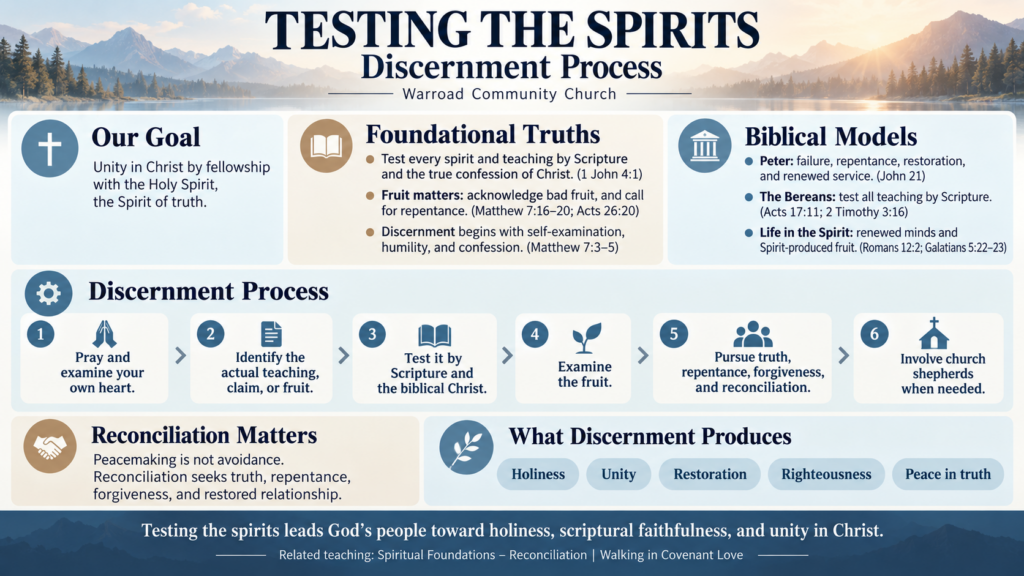
✝️✨Warroad Community Church believes that biblical discernment and reconciliation is an act of love, obedience, and fellowship with God. The goal of testing the spirits is not suspicion, accusation, or winning an argument. The goal is unity in Christ by fellowship with the Holy Spirit, the Spirit of truth, who leads us into truth and conforms us to Jesus (John 16:13; Romans 8:29). 1 John 4:1 commands us, “Beloved, do not believe every spirit, but test the spirits to see whether they are from God.” We therefore do not accept every teaching, impression, prophecy, accusation, or spiritual claim merely because it sounds sincere or uses Christian language. We test it.
Testing begins by looking at fruit. Jesus said, “You will know them by their fruits” (Matthew 7:16-20). Bad fruit must not be renamed as good fruit, excused because of personality, history, gifting, or position. At the same time, fruit is not the only test. 1 John 4 also directs us to the true confession of Jesus Christ, and the whole counsel of Scripture gives the standard by which every spiritual claim is judged. The question is not simply, “How do I feel about this?” but, “Is this true according to God’s Word, does it honor the biblical Christ, and what fruit is it producing?”
Self-Examination Comes First
Jesus commands us in Matthew 7:3-5 to deal with the log in our own eye before addressing the speck in our brother’s eye. That means testing the spirits begins with humble self-examination. Before I evaluate another person’s words or fruit, I must ask whether pride, fear, offense, self-protection, bitterness, jealousy, or a desire to control is shaping my judgment. We do not become spiritually discerning by becoming suspicious of everyone else. We become discerning by submitting ourselves to the light of Christ.
Earlier this year in the sermon Spiritual Foundations – Reconciliation, we said that reconciliation is first with God and then with one another. 1 John 1:5-10 teaches us to walk in the light, confess sin, receive cleansing through Christ, and have fellowship with one another. That sermon described reconciliation as a truth encounter: we are not battling one another; we are encountering Jesus, who is the truth, and allowing the Holy Spirit to expose what is true in both people. This posture protects discernment from becoming condemnation.
Fruit, Repentance, and Restoration
When the fruit is bad, Scripture calls us to repentance. Acts 26:20 speaks of repentance toward God and deeds appropriate to repentance. Repentance is not shame management, image repair, or merely saying the right words. It is a real turning of the heart that bears visible fruit. In that same reconciliation teaching, we used five foundational words: grace, mercy, repentance, forgiveness, and righteousness. These belong together. Grace moves toward the sinner, mercy does not delight in judgment, repentance turns from sin, forgiveness releases the debt, and righteousness walks forward in what is right before God.
Peter Shows Us the Way Forward
Peter denied Jesus three times. His failure was real, serious, and public. Yet his failure did not become his permanent identity. Peter wept, returned to Christ, and in John 21 Jesus restored him and recommissioned him: “Tend My sheep.” This matters for discernment. We do not use past failure to imprison a repentant believer in fear. When sin is acknowledged and repentance is present, Christ calls His people forward in renewed obedience. Biblical discernment therefore makes room for both honest naming of sin and genuine restoration.
The Bereans: Scripture Is the Standard
Acts 17:11 commends the Bereans because they received the word eagerly and examined the Scriptures daily to see whether these things were so. They even tested Paul’s teaching. That is healthy church life. No pastor, elder, teacher, prophet, ministry leader, or member is above the Word of God. Second Timothy 3:16-17 teaches that all Scripture is inspired by God and equips the believer for every good work. We therefore test teaching by Scripture, not Scripture by our experiences. A spiritual claim that contradicts the clear teaching of Scripture must be rejected, even if it is accompanied by confidence, charisma, signs, strong emotion, or claimed revelation.
Reconciliation Is Part of Discernment
In Walking in Covenant Love, preached March 15, 2026, we distinguished peacemaking from peacekeeping. Peacekeeping avoids discomfort and can leave sin hidden. Peacemaking seeks restored relationship in truth. It speaks in love, listens carefully, names sin from Scripture when sin is actually present, and makes repentance possible. The long-term fruit of biblical peacemaking is holiness and unity. The motive is love for the person and concern for his or her soul, not self-protection.
This is important because testing the spirits is not permission to assign motives, spread suspicion, or label every disagreement as demonic. We test what is being taught and what is being produced. We distinguish facts from assumptions. When a brother or sister is involved, Matthew 18:15-17 and Galatians 6:1 give us a path: go personally, seek truth, restore gently, and involve mature believers or elders when the matter cannot be resolved privately. The goal is always to win the brother, protect the flock, honor Christ, and remain in the light.
Discernment Process
1. Begin with prayer and self-examination. Ask the Holy Spirit to search your heart. Confess your own sin and surrender fear, offense, pride, and predetermined conclusions (Matthew 7:3-5; Psalm 139:23-24).
2. Identify what is actually being tested. State the teaching, claim, behavior, or fruit accurately. Do not judge hidden motives or build a case from rumor.
3. Test it by Scripture and by the biblical Christ. Ask whether it agrees with the apostolic gospel, the character and commands of Jesus, and the whole counsel of God’s Word (1 John 4:1-3; Acts 17:11; 2 Timothy 3:16-17).
4. Examine the fruit. Look for truth, repentance, righteousness, love, humility, peace, patience, faithfulness, and self-control. Persistent bad fruit is a warning that must be addressed rather than ignored (Matthew 7:16-20; Galatians 5:22-23).
5. Pursue reconciliation in love. When sin or error affects relationships, go to the person. Speak truth with gentleness and courage. Seek understanding, repentance, forgiveness, and restoration rather than public accusation or avoidance (Matthew 18:15; Galatians 6:1).
6. Receive correction and watch the continuing fruit. Discernment applies to all of us. A godly response to correction is not perfection but humility, teachability, repentance, and a renewed walk in truth.
7. Involve the church’s shepherds when necessary. If serious doctrinal error, harmful spiritual claims, or unresolved sin continue, bring the matter to mature believers and the elders according to Scripture. The purpose is protection, clarity, restoration, and peace under Christ.
Living in the Spirit
Romans 12:2 calls us to be transformed by the renewing of our minds so that we may prove what the will of God is. Testing the spirits is part of that renewed life. We reject conformity to the world, receive the truth of Scripture, and walk by the Holy Spirit. The Spirit of truth will not lead us away from the Word He inspired, away from Jesus, or into fruit that contradicts His character. Where He leads, the fruit of the Spirit grows (Galatians 5:22-23), sin is brought into the light, repentance becomes possible, and Christ is formed in His people.
Conclusion
Our position at Warroad Community Church is that testing the spirits is a normal and necessary part of faithful Christian fellowship, reconciling relationships that are strained resulting to unity in Jesus Christ. We will test spiritual claims by Scripture, the biblical confession of Jesus Christ, and the fruit they produce. We will begin with ourselves, refuse gossip and speculation, acknowledge bad fruit honestly, call one another to repentance, forgive where repentance and reconciliation are sought, and pursue restoration in the way Jesus commands. We are not seeking unity by avoiding truth. We are seeking unity in Christ through the Holy Spirit, the Spirit of truth. As we walk in the light together, the Lord makes us a holy, reconciled, discerning people who increasingly look like Jesus.
Related Warroad Community Church reconciliation teachings: Spiritual Foundations – Reconciliation (February 15, 2026); Walking in Covenant Love (March 15, 2026).
Download this as a PDF