Opening Summary ✨✝️
Forgiveness is not merely a personal self-improvement goal; it is a gospel-shaped way of life that mirrors the heart of God. In Christ, our immense debt of sin has been forgiven, and that mercy becomes the pattern for how we treat others. The sermon calls us to live “in the spirit of forgiveness,” pursuing reconciliation wherever possible and refusing to let bitterness remain. As a church family committed to determined discipleship through relationship, we practice forgiveness so love and unity can flourish among us.
Doctrine
Doctrine of Forgiveness and Repentance (Gospel-shaped Mercy):
God is “a God of forgiveness… abounding in lovingkindness,” and He calls His people to reflect His mercy (Neh. 9:17b). Forgiveness is rooted in the character of God and accomplished through the saving work of Christ; therefore, believers must forgive from the heart, as those who have been forgiven an immeasurable debt (Matt. 18:23–35). Yet Scripture also teaches that forgiveness is not a careless enabling of sin: gospel forgiveness is joined to repentance and fruit, and relational restoration often requires repentance and truth (Acts 2:38; Luke 17:3–4).
Opening Prayer
Father in heaven, we come hungry for Your Word and humble before Your holiness. We ask You to search our hearts and expose every root of bitterness, pride, and self-justifying spirit. Lord Jesus, thank You for the cross—You paid our unpayable debt and commanded us to forgive from the heart; give us grace to obey You with sincerity and courage. Holy Spirit, convict us where we are resisting truth, soften what has grown hard, and teach us how to pursue reconciliation in love, with wisdom and purity, for the glory of God and the good of Your church family.
Ice Breaker
Think of a time someone showed you unexpected kindness when they could have held something against you. What did that kindness do in your heart—did it soften you, motivate change, or restore trust?
Topics (Major Sermon Themes)
1) Forgiveness Reflects the Heart of God
Summary narrative:
The sermon begins by grounding forgiveness in the character of God—He is “a God of forgiveness,” and when believers forgive, they mirror His mercy. Jesus’ instruction to forgive “seventy times seven” is not a math problem but a call to live as people whose entire debt has been paid. The parable of the unforgiving slave exposes how outrageous it is to receive mercy from God and then deny mercy to others; unforgiveness is treated as serious hypocrisy before heaven. This theme aims at our Life Group culture: hungry for God’s ways, humble about our own sins, teachable toward correction, and relationally committed to love.
Scriptures used: Psalm 32:5; Matthew 18:21–35; Nehemiah 9:17b.
Key quotes from the speaker (for remembrance):
- “Unforgiveness angers God… My heavenly Father will also do the same to you if each of you does not forgive his brother from your heart.”
- “Forgiveness… isn’t just a transaction… but a reflection of God’s character.”
Discussion questions (5):
- Where do you most feel tempted to “keep score” (even quietly) instead of forgiving from the heart?
- In the parable (Matt. 18:23–35), what reveals that the servant did not truly grasp mercy? How does that apply to us?
- How does Psalm 32:5 shape a hungry, humble, teachable approach to confession and forgiveness?
- What does it look like, practically, to “live in the spirit of forgiveness” before a person ever repents?
- What would change in our Life Group if we truly treated unforgiveness as spiritually dangerous—not “normal”?
2) Forgiveness Begins with God (Gospel, Repentance, and Fruit)
Summary narrative:
Pastor Daren presses that forgiveness is not a vague “be nice” message; it is gospel doctrine. At Pentecost, Peter preaches Christ crucified and risen, and the crowd is pierced—then comes the command: repent for the forgiveness of sins. The sermon explicitly rejects a “universal forgiveness/universal salvation” idea; biblical forgiveness is connected to repentance and produces fruit. That fruit shows up in Acts 2: devotion to Scripture, fellowship, communion, and prayer—exactly the relational discipleship environment Life Groups are meant to strengthen.
Scriptures used: Luke 23:34; Acts 2:36–42.
Key quotes from the speaker:
- “I’m not talking about a doctrine of universal… salvation… forgiveness… comes with the command, the condition of repentance.”
- “The fruit here… was… devotion to studying the word… to fellowship… to prayer.”
Discussion questions (5):
- Why is it spiritually dangerous to speak about forgiveness while avoiding repentance?
- In Acts 2, what does “pierced to the heart” look like today—how would you recognize it in yourself?
- Which “fruit” of Acts 2:42 do you most need to grow in (Word, fellowship, communion, prayer)? Why?
- How can Life Groups support repentance in a way that is both truthful and tender (hungry/humble/teachable)?
- Who might God be calling you to share the gospel with—where repentance and forgiveness must both be spoken?
3) Reconciliation Is the Heart of Love (Relational Discipleship in Action)
Summary narrative:
The sermon ties forgiveness to reconciliation by taking us into the Lord’s Prayer: we ask the Father to forgive us as we forgive others. That “as” is meant to form a covenant-minded community where mercy is practiced, not merely admired. Galatians 6:2 is used to show a relational reality: you cannot bear one another’s burdens while holding bitterness in your heart—bitterness blocks love. The sermon’s direction is intensely Life Group-shaped: devotion to the Word and prayer should overflow into reconciling love among the church family.
Scriptures used: Matthew 6:9–15; Galatians 6:2.
Key quotes from the speaker / notes:
- “We cannot bear one another’s burdens when we have a bitter heart toward them!”
- “Reconciliation is love in action.”
Discussion questions (5):
- What does Matthew 6 reveal about how seriously Jesus takes relational forgiveness inside His people?
- Where have you experienced bitterness limiting your ability to love, serve, or pray for someone?
- How can our Life Group practice “burden-bearing” in a way that builds trust and deepens discipleship?
- What is the difference between “wanting reconciliation” and “taking steps toward reconciliation”?
- How does being hungry, humble, teachable protect reconciliation from turning into blame, pride, or avoidance?
4) A Forgiving Spirit Is Unconditional, Even When Forgiveness Is Conditional (Wisdom, Boundaries, and Hope)
Summary narrative:
Pastor Daren makes a careful distinction: believers should maintain a heart ready to forgive, but relational restoration may require repentance—especially where ongoing harm, manipulation, or abuse exists. Luke 17 teaches rebuke and forgiveness upon repentance; Matthew 18 shows a process of confrontation and, when needed, church involvement—love does not pretend evil is safe. Romans 12:18 calls us to do what depends on us: pursue peace and remain open to reconciliation, while trusting God’s justice. This is deeply pastoral for Life Groups: we must be relational and hopeful, yet also wise and protective, refusing to enable sin while refusing to harden our hearts.
Scriptures used: Luke 17:3–4; Romans 12:18; Matthew 18:15–18; (also referenced: Luke 23:34; Acts 7:59–60).
Key quotes from the speaker / notes:
- “God isn’t about enabling abusers… God sets boundaries. Justice has a meaning.”
- “While forgiveness depends on repentance, the spirit of forgiveness should never waver nor be denied.”
Discussion questions (5):
- How would you explain (biblically) the difference between a forgiving spirit and relational restoration?
- What fears make it hard for you to rebuke lovingly (Luke 17:3) when necessary?
- How can a Life Group support someone seeking reconciliation while also protecting them from harm?
- What does “so far as it depends on you” (Rom. 12:18) look like in a real strained relationship?
- Where do you need the Holy Spirit to help you replace bitterness with hope—hoping for repentance and healing?
Group Prayer Points (for Life Group time)
Use these prompts gently; invite, don’t force. Make room for silence and honesty.
- Confession and cleansing: “Father, show me where I’ve covered sin (self-justification) instead of confessing it. Cleanse me and restore joy.” (Ps. 32:5)
- Release of bitterness: “Lord, I renounce every grudge and desire to punish. Pull out every root of bitterness and replace it with Christlike mercy.”
- Grace to forgive from the heart: “Jesus, as You forgave me, help me forgive—truthfully, sincerely, and without pretending.” (Matt. 18:35)
- Repentance and fruit: “Holy Spirit, grant repentance where it is needed—in me first. Produce the fruit of devotion to Your Word, fellowship, communion, and prayer.” (Acts 2:38–42)
- Courage for reconciliation: “Father, give me courage to take the first step toward peace where possible—an apology, a conversation, or releasing the offense in prayer.”
- Wisdom and boundaries: “Lord, teach us to love without enabling sin. Give leaders and members wisdom for safety, truth, and order.” (Matt. 18:15–18)
- Church family unity: “Make our Life Groups places of burden-bearing and healing—where Your kingdom is seen in covenant love.” (Gal. 6:2)
Closing Prayer
Father, we thank You for Your forgiving heart and for the mercy You have shown us in Christ. Lord Jesus, keep us near Your cross so we never minimize the debt You paid, and make our forgiveness toward others sincere and from the heart. Holy Spirit, seal these truths into our daily thinking—train us to notice bitterness quickly, to confess quickly, to forgive quickly, and to pursue reconciliation wisely. Make us hungry for Your ways, humble under Your Word, teachable toward correction, and deeply relational in covenant love—so that our church family displays the kingdom of God on earth.
Challenge for the Week
Choose to live in the spirit of forgiveness this week: refuse to rehearse offenses, and instead rehearse the gospel—how much you have been forgiven. Take one concrete step toward peace where possible, and ask the Holy Spirit to make forgiveness your instinct, not your exception.
Daily Devotionals
Day 1 — Remember the Debt You Were Forgiven
Focus: Matthew 18:23–35
Reflection: Where have I treated a small offense as if it were greater than the mercy God has shown me?
Challenge: Write down one offense you keep “replaying.” Pray: “Father, I forgive from my heart—because You forgave my greater debt.”
Day 2 — Forgiveness Begins with God (Repentance and Fruit)
Focus: Acts 2:36–42
Reflection: Is my Christianity bearing Acts 2 fruit—devotion to the Word, fellowship, communion, prayer?
Challenge: Choose one “fruit” area to practice intentionally today (15 minutes in Scripture, or a prayer call, or a reconciliation text).
Day 3 — The Lord’s Prayer Shapes My Relationships
Focus: Matthew 6:9–15
Reflection: How does the phrase “as we also have forgiven” confront my habits and hidden resentments?
Challenge: Pray the Lord’s Prayer slowly. Pause at “forgive us… as we forgive.” Name one person and ask God for a tender heart.
Day 4 — A Forgiving Spirit with Wisdom and Boundaries
Focus: Luke 17:3–4; Matthew 18:15–18
Reflection: Do I avoid truth-telling because I fear conflict? Or do I push “forgiveness” in a way that ignores safety and repentance?
Challenge: Ask for wisdom: “Holy Spirit, teach me loving courage—truth without harshness, mercy without enabling.”
Day 5 — Practice Daily, Pray for Reconciliation
Focus: Ephesians 4:32; Galatians 6:2
Reflection: What does kindness and tenderheartedness look like in my next conversation?
Challenge: Practice forgiving a “small offense” today on purpose, then pray for reconciliation in your family, Life Group, and community.
Additional Study for New Believers (60 minutes total)
Part 1 (15 minutes) — Read and Meditate On
Read slowly: Psalm 32:5; Ephesians 4:32; Acts 2:38; Matthew 6:14–15; Luke 17:3–4.
Write Short Reflections (5–7 sentences):
- What is one thing you learn about God’s forgiveness?
- What is one step of obedience Jesus is calling you into this week?
Part 2 (15 minutes) — Study of Christian Thought
Recommended reading (short, clear, gospel-centered): Ligonier devotional “A Prison for Our Souls” (for bitterness and forgiveness).
https://learn.ligonier.org/devotionals/prison-for-our-souls
Writing assignment: In one paragraph, answer: “How does the gospel free me from the ‘prison’ of bitterness?”
Part 3 (15 minutes) — Theological Reflection on Forgiving When Repentance Is Complicated
Recommended reading: Desiring God interview “The Major Obstacle in Forgiving Others” (helps think carefully about repentance, forgiveness, and the heart).
https://www.desiringgod.org/interviews/the-major-obstacle-in-forgiving-others
Writing assignment: List two biblical principles you learned that will help you forgive with both mercy and wisdom.
Part 4 (15 minutes) — Prayer and Declaration Practice
- Pray (5 minutes): Confess bitterness; ask for tenderness; ask for courage to pursue peace where possible.
- Write a declaration (5 minutes): Start with, “Because God in Christ forgave me, I will…” (Eph. 4:32).
- Read a Psalm aloud (5 minutes): Psalm 32 (focus on confession and forgiveness).
Additional Study for Mature Believers (60 minutes total)
Part 1 (15 minutes) — Read and Meditate On
Read with a pen in hand: Matthew 18:21–35; Matthew 18:15–18; Romans 12:18; Ephesians 4:32.
Write Short Reflections:
- Where does my heart still want “justice” more than mercy?
- Where do I need to practice courageous truth (Matt. 18) as an act of love?
Part 2 (15 minutes) — Study of Christian Thought (Reformed/Puritan)
Recommended reading: John Owen, “The Forgiveness of Sin: A Practical Exposition Upon Psalm 130” (free ebook page with downloads).
URL (copy/paste):
https://www.monergism.com/forgiveness-sin-practical-exposition-upon-psalm-130-ebook
Writing assignment: Summarize Owen’s core argument in 6–8 bullet points, then write one paragraph: “How does forgiveness produce holy fear, not presumption?”
Part 3 (15 minutes) — Theological Reflection on the Lord’s Prayer and Forgiveness
Recommended reading: Thomas Watson (Puritan), “The Fifth Petition in the Lord’s Prayer” (CCEL). https://www.ccel.org/ccel/watson/prayer.viii.html
Writing assignment: How does Watson’s treatment of “debts” help you disciple others away from shallow forgiveness (sentiment) into gospel forgiveness (truth + mercy)?
Part 4 (15 minutes) — Prayer and Declaration Practice (for leaders and disciplers)
- Pray in three movements (8 minutes):
- Adoration: God is “gracious and compassionate… abounding in lovingkindness.” (Neh. 9:17b)
- Confession: name unforgiveness, harshness, avoidance, fear of hard conversations.
- Intercession: pray for repentance and reconciliation in specific relationships in the church.
- Write a “Life Group reconciliation commitment” (4 minutes): one paragraph outlining how you will pursue peace, truth, and safety biblically.
- Read Psalm 130 (3 minutes): Connect forgiveness with reverent worship and hope.
Key Verses (NASB95)
Psalm 32:5 – Used as an opener to show that God welcomes confession and truly forgives, setting the pattern for a humble, teachable heart before God.
Matthew 18:21–22 –This frames forgiveness as a heart posture reflecting God’s limitless mercy—not keeping score.
Matthew 18:23–35 –Central text: unforgiveness is exposed as hypocrisy against the gospel. Emphasize “from your heart”—not mere outward words, but inward mercy shaped by God’s mercy.
Nehemiah 9:17b –Used to show God’s forgiving character even toward stubborn people—our forgiveness reflects Him.
Luke 23:34 – Shows Jesus’ forgiving spirit even under suffering—used to ground forgiveness in Christ, not self-effort.
Acts 2:36–38 – The sermon explicitly rejects “universal forgiveness/universal salvation” thinking—biblical forgiveness is joined to repentance and fruit.
Acts 2:39–42 – This was used to show the fruit of repentance and forgiveness: devotion to Scripture, fellowship, communion, and prayer—exactly what Life Groups aim to cultivate.
Matthew 6:9–13 – Highlights reconciliation as love’s heartbeat: we ask forgiveness as we forgive. This is meant to shape our relational discipleship.
Matthew 6:14–15 – A sobering warning from Jesus. The sermon uses it to press the seriousness of unforgiveness and the necessity of a forgiving heart.
Galatians 6:2 – The sermon connects unforgiveness and bitterness to the breakdown of burden-bearing and fellowship—Life Groups require mercy to function.
Luke 17:3–4 Used to teach the difference between (1) a constant forgiving spirit and (2) relational forgiveness/restoration which often requires repentance—plus the need for boundaries with unrepentant harm.
Romans 12:18 – Calls the group to do what depends on us—pursue peace and reconciliation without pretending sin is harmless.
Acts 7:59–60 – Stephen models gospel-formed forgiveness while suffering; helpful when the group discusses difficult or unfair situations.
Matthew 18:15–18 – Used to show boundaries and church order: forgiveness is never “enablement,” and love sometimes requires truth, process, and protection of the flock.
Ephesians 4:32 – Final anchor verse: we forgive because we were forgiven. It’s the “no root of bitterness” call applied to the whole church.
Supporting Verses
- Matthew 6:12–14 — listed as a passage for meditation on God’s forgiveness and our forgiving others.
- Proverbs 17:9 — supports the call to cover transgressions in love rather than repeating offenses.
- Colossians 3:13 — forgiveness as a Christlike practice in community.
- 2 Chronicles 7:14 — humility and turning to God as a pathway to mercy and healing.
- Luke 6:37 — warns against judgmentalism and commends mercy.
- Proverbs 28:13 — confession and forsaking sin to find compassion.
- Mark 11:25 — prayer connected to forgiving others.
- Micah 7:18 — God’s delight in lovingkindness and pardoning.
- 2 Chronicles 30:9b — God’s graciousness when people return.
- 1 John 2:2 — Christ’s atoning work as the basis of forgiveness.
- Acts 3:19 — repentance leading to forgiveness/refreshing.
- James 5:14–15 — confession/prayer and spiritual restoration.
- Isaiah 55:7 — return to the Lord who will abundantly pardon.
- Acts 17:30 — God commands all people to repent.
- Jeremiah 3:12 — God’s call to return; His merciful posture.
(Also alluded in the sermon: “those forgiven much, love much” — commonly connected to Luke 7:47; and “His mercies are new” — commonly connected to Lam. 3:22–23.)
Doctrine Review
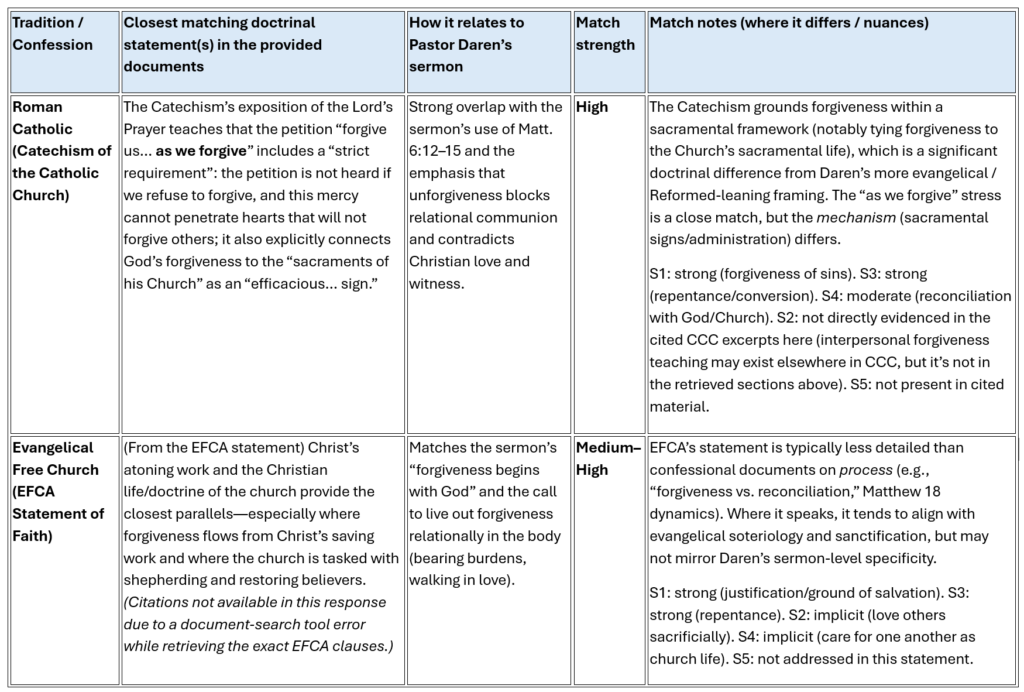
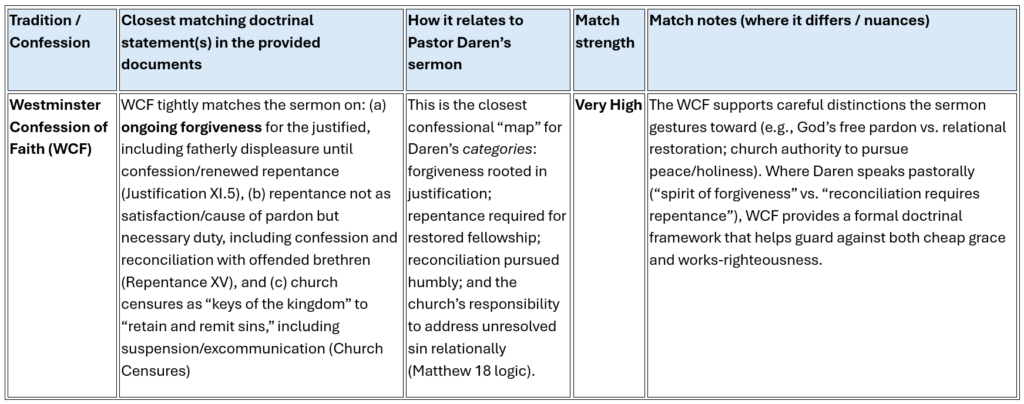
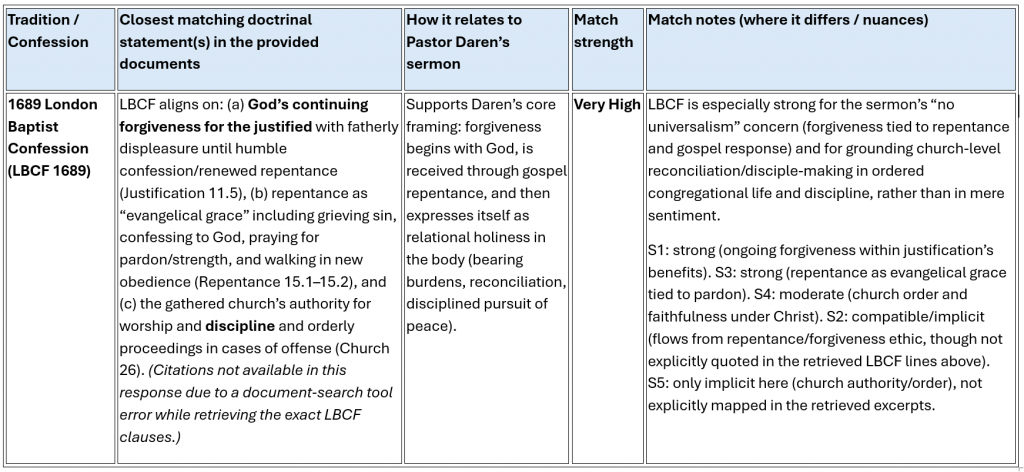
Pastor Daren’s message presses the church to enter the New Year with a distinctly Christian posture: receiving God’s forgiveness in Christ and then practicing forgiveness toward others as a lived-out expression of the gospel, refusing bitterness and relational “baggage.” The sermon also ties forgiveness to repentance and reconciliation in relationships (including difficult situations), urging believers to pursue peace and restoration in a way that honors Christ and protects the church’s unity. In the denominational documents you provided, this theme most directly overlaps with those traditions’ teachings on repentance and remission of sins, and on the church as the place where the gospel is proclaimed and forgiveness is ministered—though the traditions differ sharply on how forgiveness is ordinarily administered (e.g., sacramental confession/absolution vs. gospel proclamation and repentance/faith). The sermon’s practical emphasis on interpersonal forgiveness and relational reconciliation is strongly compatible with Protestant confessional ethics (and broadly affirmed across traditions), while Roman Catholic and Lutheran sources add distinct sacramental frameworks that go beyond what the sermon itself appears to emphasize. (Sermon grounding: forgiveness and reconciliation as central aims.)
“Major doctrine” lens used for matching (from the sermon)
- S1 — God’s forgiveness of sins is a gospel reality believers must receive (not self-earned).
- S2 — Believers are called to forgive others and pursue reconciliation (practically, relationally).
- S3 — Repentance is connected to forgiveness and relational restoration (reconciliation language).
- S4 — The church must handle conflict/redemption of relationships wisely (unity and protection of the body implied in reconciliation focus).
- S5 — (If present in the sermon) Matthew 18/process-type boundaries and discipline (not assessed here unless explicitly stated in the sermon excerpting you provided).